Ever since Hezbollah was established in
1985, it has been involved in a long-running conflict with Israel as part of the
Iran–Israel proxy conflict. Its goal, driven by genocidal antisemitism, is to
wipe Israel off the face of the earth. Its 1985 manifesto reportedly states
"our struggle will end only when this entity [Israel] is obliterated. We
recognize no treaty with it, no ceasefire, and no peace agreements."
Therefore, there is no realistic hope
for peace between Israel and Hezbollah unless Hezbollah renounces its goal of
Israel’s obliteration. From 1985 to 2000, Hezbollah was the primary force
opposing Israel and the South Lebanon Army in the South Lebanon conflict. After
Israeli force completely withdrew from the southern Lebanon in 2000, Hezbollah
continued to launched many cross-border raids into northern Israel, as well as
terrorist attacks on the U.S. target in the Middle East.
- On October 7, 2000, Hezbollah militants abducted and
killed three Israeli soldiers while they were patrolling the border between
the Israeli-occupied Golan Heights and Lebanon.
- During and after the Iraq War in 2003, Hezbollah
helped training Shia insurgents against the U.S. troops and its allies.
- On July 12, 2006, Hezbollah militants fired rockets
at Israeli border towns as a diversion for an anti-tank missile attack on
two armoured Humvees patrolling the Israeli side of the border fence. This
ignited the 2026 Lebanon War. Israel responded with airstrikes and artillery
fire on targets in Lebanon, damaging Lebanese infrastructure, and launched a
ground invasion of southern Lebanon.
- On January 15, 2008, Hezbollah bombed a US Embassy
vehicle in Beirut, killing three Lebanese.
- On January 28, 2015, Hezbollah launched an ambush
against an Israeli military convoy in the Israeli-occupied Shebaa Farms,
killing 2 and wounding 7 Israeli soldiers and officers.
On October 8, 2023, Hezbollah launched
rockets and artillery at Israeli positions, stating that the attack was in
solidarity with Palestinians in Gaza following the October 7 Hamas-led attack on
Israel from the Gaza Strip. Israel retaliated by launching drone strikes and
artillery fire against Hezbollah positions. Israel also carried out airstrikes
across Lebanon and in Syria.
The conflict soon escalated into a
prolonged exchange of bombardments, causing extensive displacement on both
sides. Over 96,000 people in northern Israel and more than 111,000 in southern
Lebanon have been displaced from their homes during the war.
In September 2024, Israel intensified its operations
with two waves of electronic device explosions targeting Hezbollah's
communication systems. It later assassinated several of the group's top leaders,
including Secretary-General Hassan Nasrallah and his successor, Hashem
Safieddine. On October 1, 2024, the Israeli military launched a ground invasion
of southern Lebanon.
On November 27, 2024, a 60-day ceasefire agreement was
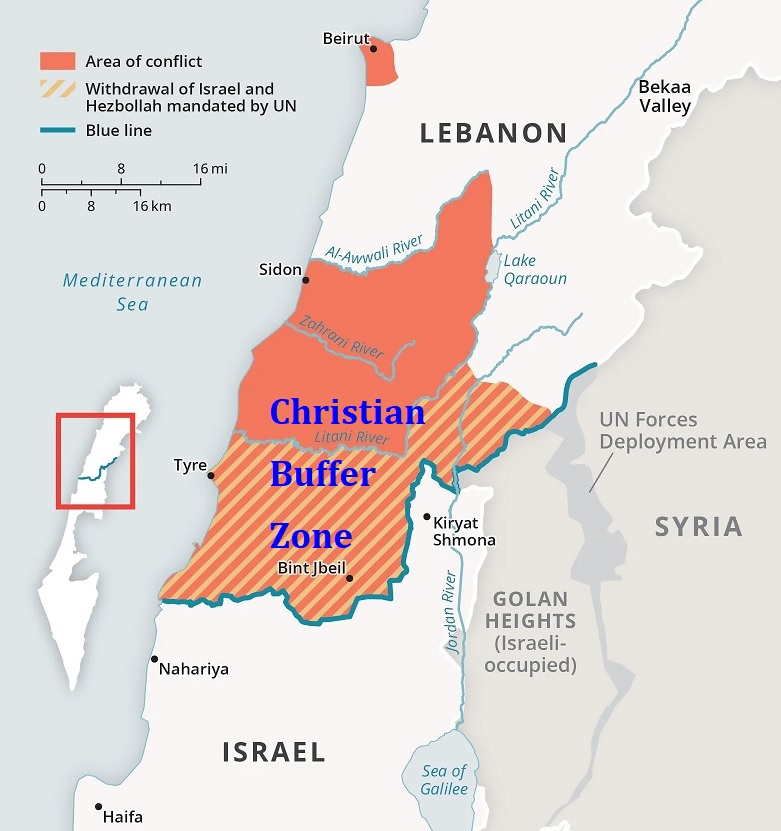
brokered, which required Hezbollah to move its fighters north of the Litani
River, approximately 30 kilometres (19 miles) from the Israeli border, while
Israel began withdrawing its forces from southern Lebanon. Although the
ceasefire was later extended indefinitely, airstrikes resumed between Hezbollah
and Israel on March 2, 2026, following the 2026 Iran war and the killing of Ali
Khamenei on February 28, 2026.
On June 3, Israel and Lebanon reached an agreement, facilitated by the United States, to renew the ceasefire and establish “pilot zones.” On June 4, Hezbollah rejected the
publicly announced truce, demanding instead a comprehensive ceasefire and the full withdrawal of Israeli forces from Lebanon.
They are playing the same trick as they did before. Despite further attempts to reach another ceasefire at the request of the United States, such
an agreement with an extremist militia group is unlikely to last long.
Create A Christian Buffer
Zone in Southern Lebanon Between Israel and Hezbollah Settlement
The only permanent solution to end the conflict between Israel and Hezbollah is to physically separate the two sides by creating a
Christian Buffer Zone in southern Lebanon, where only Christian Lebanese would be allowed to settle. The Lebanese government would retain sovereignty over the buffer zone and coordinate population swaps between Christians and Muslims in the area. The Lebanese Army and the Israel Defense Forces could form a joint security force to protect the zone and ensure there is no direct contact between Israeli and Hezbollah settlements.
In the past twenty years, whenever Israel has withdrawn from southern Lebanon, Hezbollah has taken over the area and resumed cross-border attacks on northern Israel. Israel has then retaliated by bombing Hezbollah positions or invading southern Lebanon. This cycle of attack and retaliation has continued, inevitably causing more casualties on both sides, including civilians.
In May 2000, Israel completely withdrew
from southern Lebanon without establishing a buffer zone. This led to continuous
conflicts with Hezbollah for the next 25 years. In August 2005, Israel
completely withdrew from Gaza to let Palestinians govern the Gaza Strip
themselves. It ended up with the terrorist attack led by Hamas on October 7,
2023, which triggered the Gaza war that destroyed the Gaza Strip.
As long as Hezbollah and Hamas continue to hold the
genocidal doctrine of obliterating Israel from the face of the earth, there can
be no peace between them and Israel. If this time Israel withdraws from southern
Lebanon without creating a buffer zone between itself and Hezbollah, another
military conflict or war will likely erupt in the near future. Southern Lebanon will once again be destroyed by war, just as Gaza was destroyed.
Recently, the United States has facilitated a trilateral framework between the United States, Israel, and Lebanon aimed at ending the conflict between Israel and Lebanon. The plan involves disarming
Hezbollah and the progressive withdrawal of the Israel Defense Forces (IDF) from southern Lebanon once Hezbollah is disarmed. This framework appears promising, but it will be difficult to implement.
As the majority of the Lebanese army consists of Shia Muslims, they are unlikely to fight hard to disarm Hezbollah — just as the Afghan army failed to fire a single shot against the Taliban, despite the United States spending billions of dollars on military support and training it. After the framework was announced on June 26, 2026, Shia Muslims began rioting in Beirut, the capital of Lebanon, in support of Hezbollah. If they return to southern Lebanon, Hezbollah could once again re-emerge among them, turn the area into another Gaza — a launchpad for future attacks against Israel — and eventually be destroyed again.
Therefore, only a Christian Buffer Zone can physically separate Israel and Hezbollah and permanently end the conflict between them. With a
Christian Buffer Zone between Israel and Hezbollah, both Christian Lebanese and Israelis could live peacefully side by side along the Israel–Lebanon border. This would provide a realistic path to permanently ending the cycle of military conflicts between Israel and Hezbollah.
While the Lebanese government is responsible for relocating Muslims out of this area, Israel should also help Lebanese Christians move into this Christian Buffer Zone and protect and restore the Christian heritage in this area. This is the key to bringing God’s blessing for lasting peace and prosperity in the region.
Download
the PDF Version of this Revelation on the War in Iran