Since the Islamic Revolution in 1979, Iran's extremist Islamic regime has oppressed its people for 47 years with ruthless, medieval-style laws rooted in rigid Sharia interpretations. These policies have impoverished most Iranian people while enriching the ruling clerical elite.
At the end of 2025, nationwide protests erupted across Iran, driven by deep-seated grievances including economic collapse, corruption, and long-standing demands for greater freedoms. These demonstrations quickly grew into one of the largest challenges to the regime in decades, with Iranians abroad organizing supportive rallies in solidarity.
Tragically, the extremist Islamic regime responded with extreme brutality, massacring over 35,000 mostly unarmed protesters during the crackdown in early January 2026. This unforgivable atrocity—among the deadliest episodes of state repression in modern Iranian history—has been condemned globally as mass murder against the nation's own citizens.
In response to this bloodshed, exiled Iran Crown Prince Reza Pahlavi called for global demonstrations in solidarity with those inside Iran. On February 14–15, 2026, over one million people held massive rallies across Europe, North America, and Australia, voiced their support for the Iranian people's struggle against the regime and called for international intervention to end this murderous regime's ongoing atrocities.
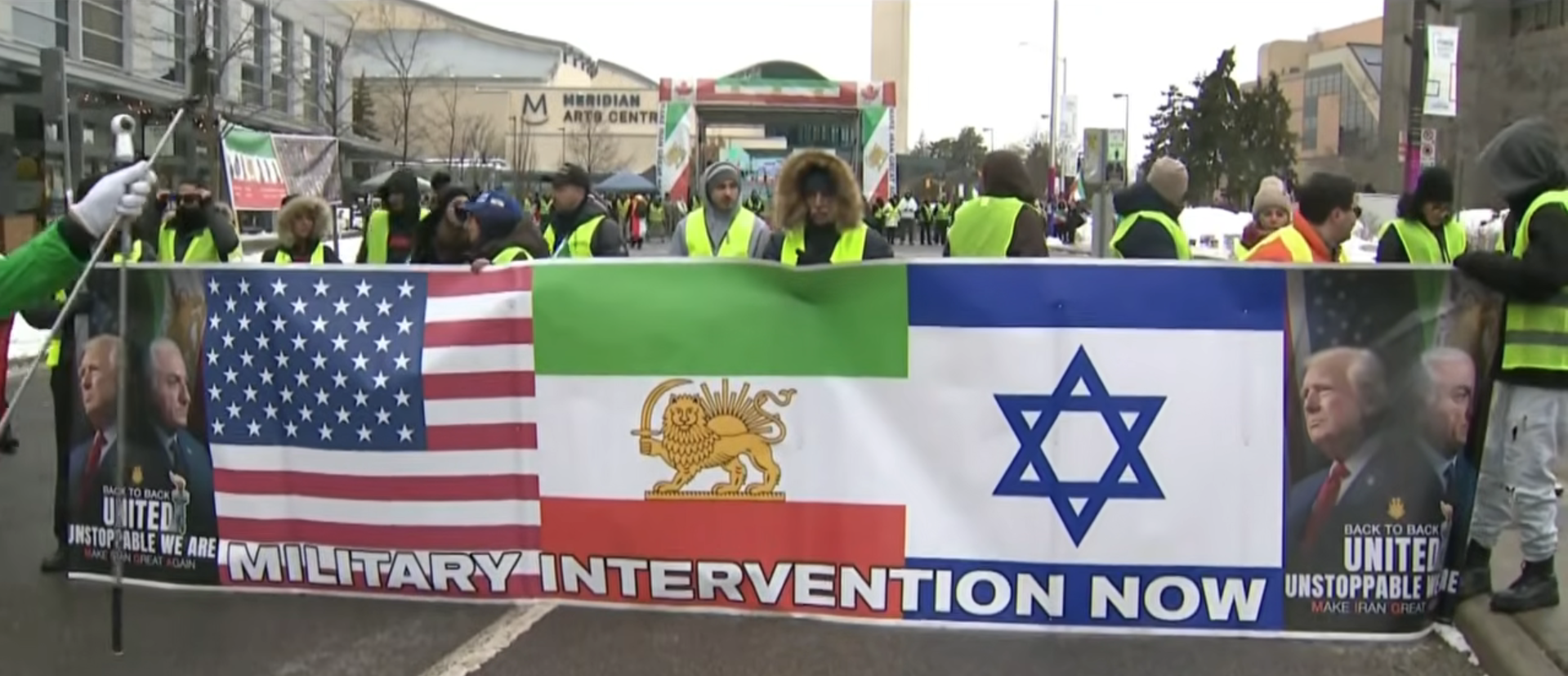
The Iran Rally at Toronto on February 14, 2026
On February 28, 2026, the United States and Israel launched a joint military operation against the Islamic Republic of Iran, dubbed "Operation Epic Fury" by the US. Within the first week, coordinated airstrikes destroyed numerous Iranian Revolutionary Guard Corps (IRGC) bases, sank most of Iran's navy vessels, and neutralized a significant portion of its military aircraft and ballistic missile capabilities.
Iran's Supreme Leader Ayatollah Ali Khamenei and over two dozen top military, security, and government officials—including the defense minister, IRGC commander, and others—were killed in the initial US-Israeli strikes. The regime subsequently elected Khamenei's son, Mojtaba Khamenei, as the new Supreme Leader, who has vowed retaliation against the US, Israel, and their Middle Eastern allies.
Although Iran's navy and air force suffered devastating losses from U.S. and Israeli airstrikes,
the regime has continued launching numerous missile and drone attacks against Israel, Dubai, and neighboring countries hosting U.S. military bases (such as in Bahrain, Qatar, and the UAE). Iran has effectively blocked the Strait of Hormuz, halting about 20% of global oil transit and driving up crude prices by around 40%. A prolonged conflict, similar to the drawn-out war in Ukraine, could severely disrupt the world economy through sustained energy shocks, higher inflation, and supply chain strains.
Despite the US and Israel's superior missiles and weaponry, fully controlling Iran's vast territory—spanning 636,372 square miles (roughly 80 times Israel's size and larger than Texas and California combined)—remains challenging. With most senior Iranian leaders and generals eliminated, the regime lacks authoritative figures for ceasefire negotiations, leading to ongoing attacks on vessels in the Strait of Hormuz and on neighboring countries hosting US military bases.
Thus, a viable path to ending the war may involve the US and Israel supporting regime change by establishing a new, pro-Western Iranian government. Exiled Crown Prince Reza Pahlavi, who has resided in the United States for over 47 years, emerges as a strong candidate to lead such a transitional administration.
I. Establish a New Iranian Government Led by Exiled Crown Prince Reza Pahlavi
After 47 years of oppression under Iran's extremist Islamic regime, many Iranians yearn for a return to the secular, pre-revolutionary era under Mohammad Reza Shah Pahlavi (r. 1941–1979), the last Shah and father of exiled Crown Prince Reza Pahlavi. Following the Shah's death in 1980, Reza Pahlavi—his eldest son and legitimate heir—has emerged as a prominent figure in the opposition against the extremist Islamic regime. During the massive 2025–2026 protests, calls for his return and leadership grew significantly among demonstrators seeking regime change.
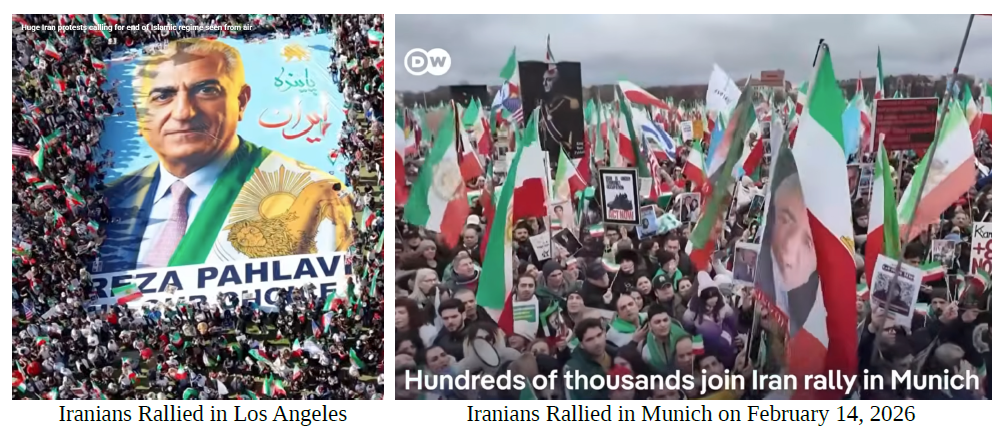
On February 14-15, 2026, over one million Iranians and supporters rallied worldwide—in major gatherings in Munich (around 250,000), Toronto (estimated 350,000+), Los Angeles, and other cities across Europe, North America, and Australia—in response to Reza Pahlavi's call for a "Global Day of Action." These demonstrations expressed solidarity with protesters inside Iran and highlighted his considerable influence among the Iranian people demanding an end to the regime's rule.
Iran's population exceeds 92 million, with Persians (Fars) comprising about 60–61%, Azeris around 16–20%, Kurds approximately 10%, and other groups making up the rest. Many Persians take pride in Iran's ancient heritage and culture, predating the Arab-Muslim conquest, and seek a leader who can revive that glorious history while modernizing the country and moving beyond rigid, medieval-style governance. Reza Pahlavi is viewed by his supporters as the ideal unifying figure—rooted in Persian tradition yet committed to secular democracy, long-term alliances with the United States and Israel, and guiding Iran toward prosperity and global integration.
Historical parallels are often drawn: During World War II, the United States and United Kingdom backed Charles de Gaulle's exiled French government, which eventually assumed power post-liberation after the end of World War II. In contrast, France supported Ayatollah Khomeini in exile 47 years ago to help overthrow the Shah and started the extremist Islamic regime that has been oppressing Iranian people for the last 47 years. Now, it is time for the United States and Israel to support Reza Pahlavi in establishing a new, pro-Western government to decisively end the extremist Islamic regime in Iran.
Having resided in the United States for over 47 years since the 1979 Revolution, Reza Pahlavi is deeply familiar with democratic institutions and systems. Supporters hope he could facilitate a similar transformation in Iran as General Douglas MacArthur oversaw in post-World War II Japan—overseeing stability, drafting a modern constitution, and enabling a transition to democracy and economic revival. As of March 2026, amid ongoing conflict, Reza Pahlavi has publicly stated his readiness to lead a transitional period focused on restoring order, security, freedom, and conditions for prosperity, paving the way for Iranians to freely choose their future government.
II. Call for Iranian Military Troops to Defect to the New Iranian Government to End the Extremist Islamic Regime in Iran
President Trump has called for the total surrender of Iran's Islamic regime, but many Iranians—shaped by national pride and decades of regime propaganda—remain reluctant to accept direct capitulation to the United States or Israel. However, exiled Crown Prince Reza Pahlavi has repeatedly urged Iranian military personnel, police, security forces, and officials to defect and side with the people rather than prop up what he describes as a collapsing regime. In statements throughout early 2026, including amid the ongoing U.S.-Israeli strikes, he has emphasized that defectors would have a place in a future free Iran, framing this as a path to redemption and national salvation.
Pahlavi has established formal channels for defections and claimed growing numbers of military and security personnel are signaling readiness to switch sides or have already done so quietly. Supporters argue that his call carries unique legitimacy due to his heritage as the son of the last Shah and his widespread appeal among protesters and supporters. This approach—leveraging internal defections rather than full external surrender—could prove the most effective way to accelerate the regime's collapse without prolonged foreign occupation.
III. Support the Oppressed Iranian People with More Weapons and Ammunition to Form the New National Guards for the New Iranian Government
For 47 years since the 1979 Islamic Revolution, Iran's people have endured severe oppression under the regime: arbitrary arrests, torture, executions of political opponents, journalists, and activists; harsh restrictions on women's rights, including violent enforcement of compulsory hijab (exemplified by Mahsa Amini's 2022 death in custody, sparking the "Woman, Life, Freedom" movement); and economic devastation from mismanagement, support for regional proxies, international sanctions, and hyperinflation.
Nationwide protests erupted at the end of 2025, escalating into one of the largest challenges to the regime, with millions demanding its overthrow. In Januaray 2026, the murderous Iranian regime cut off the internet connection and began the massacre of unarmed Iranian protesters. It is estimated over 35,000 Iranians were massacred in the brutal crackdowns ordered directly by the Supreme Leader Ali Khamenei.
Many brave Iranians have demonstrated extraordinary courage, willing to risk or sacrifice their lives for freedom and dignity. Yet, unarmed and facing heavily equipped regime security forces, thousands of young protesters and civilians have been killed in brutal crackdowns by the murderous extremist Islamic regime. If these brave and determined Iranians had access to defensive weapons, they could protect themselves, resist repression more effectively, and potentially accelerate the regime's downfall from within—without relying solely on prolonged external military action.
If the United States and Israel could extend military support to the emerging transitional framework led by exiled Crown Prince Reza Pahlavi, large numbers of brave young Iranians could rally to form a new national guard under his leadership. Providing modest, cost-effective weapons—such as 100,000 to 300,000 rifles, like AK-15, along with sufficient ammunition—would be far less expensive than sustained advanced missile strikes or bombs. This could empower an internal armed resistance capable of overthrowing the extremist Islamic regime, paving the way for Iran to transition into a modern, developing nation aligned with democratic values and regional stability.
Historical examples illustrate the power of armed internal revolt: In Syria, opposition forces led by Hayat Tahrir al-Sham captured Damascus and toppled Assad's regime in under a week in December 2024, succeeding where decades of external efforts had failed. In Afghanistan, despite 20 years of U.S. training for government forces, the Taliban seized control rapidly in August 2021 as foreign troops withdrew.
These cases suggest that empowering Iran's own people with arms—rather than relying solely on external bombing—could enable them to overthrow the regime decisively. A new, people-led government under the leadership of Reza Pahlavi would likely become a strong, pro-Western ally to the United States and Israel, fostering lasting stability and peace in the Middle East.
IV. The Judgment of God on the Murderous Extremist Islamic Regime of Iran
Over the past 47 years since the 1979 Islamic Revolution, Iran's extremist regime has imposed rigid, medieval-style laws to oppress its people and plunged the nation into a modern Dark Age of authoritarian theocracy with suppression of dissent and severe restrictions on personal freedoms. It is similar to the Dark Age in the Later Medieval period in Europe (1300s–1500s), where the Catholic Church had near-absolute control over the secular world, branding dissent as heresy and enforcing it through persecution by the Inquisition. Similarly, Iran's clerical establishment exerts tight control over all aspects of Iranian people's life, punishing any deviation with imprisonment, torture, or execution through Islamic courts.
Since Islam began in the seventh century, approximately six hundred years after Christianity began in the first century, what happened in many Islamic countries today resembles what occurred during the Dark Ages in the Christian world six hundred years earlier. That’s the learning curve most major religions in the world have experienced in the past four thousand years.
Currently, the extremist Islamic regime in Iran is repeating the same mistakes the Catholic Church made during the Dark Age six hundred years ago. This pattern of repression fueled massive nationwide protests erupting in late December 2025 and intensifying into January 2026, with millions demanding an end to the regime amid economic collapse and long-standing grievances.
Tragically, the Iranian government's response was ruthless: it imposed nationwide internet blackouts to conceal its actions and carried out mass killings of unarmed protesters, with death toll estimates over 35,000. Security forces even entered hospitals to execute wounded demonstrators, detained and tortured the nurses caring for the injured. Some of the nurses were even gang-raped by the Iranian security forces and its associated militias. These are the horrific crimes against humanity for which the regime's leaders must be held accountable.
God has mercy on the long-suffering Iranian people, and the judgment of God came swiftly on those Tehran butchers who ordered the massacre of Iranian people. Since the United States of America and Israel launched the airstrike against Iran on February 28, 2026, most of those Tehran butchers who were responsible for the massacre of 35,000 Iranian people have been eliminated, including the Supreme leader of Iran Ayatollah Ari Khamenei and top commanders of the Islamic Revolutionary Guard Corps (IRGC) and Basij militia forces.
This is a clear warning to all authoritarian regimes: God is merciful toward all people on earth. No government should abuse its power to mistreat, persecute, or massacre its own citizens. If any authoritarian regime ruthlessly massacres its own people, the wrath of God will come upon it swiftly.
Regime change in Iran is now imperative to end this era of repression, especially after it massacred over 35,000 Iranian people during the nationwide protests in January 2026.
After the United States and Israel launched military strikes against Iran on February 28, 2026, the Iranian regime retaliated not only against U.S. and Israeli targets but also against neighboring countries hosting U.S. military bases—including Bahrain, Qatar, Kuwait, the United Arab Emirates, Saudi Arabia, Jordan, and others. These attacks extended to allied sites and, in some cases, civilian infrastructure.
Additionally, Iran has effectively blocked the Strait of Hormuz, halting or severely restricting about 20% of global oil flows. This has triggered an oil crisis, with crude oil prices surging by around 40%, contributing to elevated global inflation and energy costs.
On March 18, 2026, Iran began to strike on the oil refineries in Saudi Arabia and Kuwait and launched missile attacks on Qatar’s Ras Laffan Industrial City, home to the largest liquefied natural gas(LNG) export facility in the world. Most Arab nations now recognize the threat posed by this extremist Islamic regime, which is the primary sponsor of terrorism in the Middle East and a terrorist entity itself. Only regime change can eliminate the threat from Iran to its neighboring countries and bring lasting peace to the Middle East.
Before the 1979 Islamic Revolution, Iran and Israel enjoyed a good friendship under Shah Mohammad Reza Pahlavi. Iran became the first Muslim-majority country in the Middle East to recognize Israel following its establishment in 1948 after World War II. The historical ties between Persia (modern-day Iran) and the Jewish people extend back over 2,500 years.
In 539 BCE, Cyrus the Great of Persia defeated the Babylonian Empire at the Battle of Opis, conquering Babylon and ending the Babylonian captivity of the Jews. He permitted the Jewish exiles to return to Jerusalem and rebuild the Second Temple. Cyrus the Great was the only non-Jewish figure in the Hebrew Bible hailed as “messiah” or “anointed one,” in Isaiah 45:1.
Nowadays, most Jewish people remain grateful for the liberation by Cyrus the Great and view the current war on Iran as a return of the favor—liberating the Iranians from the oppressive Islamic regime in the same way Cyrus once liberated the Jews.
Persia also holds a special place in Christian tradition: the three Magi (or wise men) who followed the Star of Bethlehem to bring gifts of gold, frankincense, and myrrh to the infant Jesus are traditionally believed to have come from Persia, a region renowned for its advanced knowledge of astronomy and astrology in antiquity. Many Christians would like to help Persia—now Iran—restore its glorious history and culture.
However, the 1979 Islamic Revolution fundamentally altered Iran's trajectory. The new regime dismantled aspects of traditional Persian culture, adopted a sharply anti-Western and anti-Israel stance, and popularized slogans such as “Death to Israel” and “Death to America.”
Since the 1979 Islamic Revolution, Iran has engaged in a decades-long campaign of attacks against the United States, utilizing both direct actions and proxy forces like Hezbollah and the Houthis. Major incidents included the 1979 U.S. embassy hostage crisis, the 1983 Beirut barracks bombing, the 1996 Khobar Towers bombing, support for militias that killed over 600 U.S. troops in Iraq, and the capture of U.S. Navy vessels followed by the humiliation of the U.S. Navy in exchange for a $1.7 billion ransom in cash.
Unfortunately, none of the previous U.S. presidents dared to respond forcefully to these attacks by this extremist Islamic regime in Iran. President Trump is the only U.S. president who has the courage and determination to fight back and defeat this extremist Iranian regime.
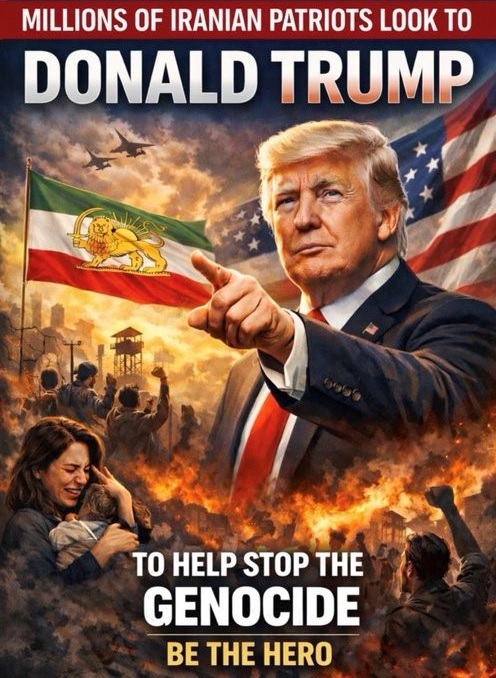
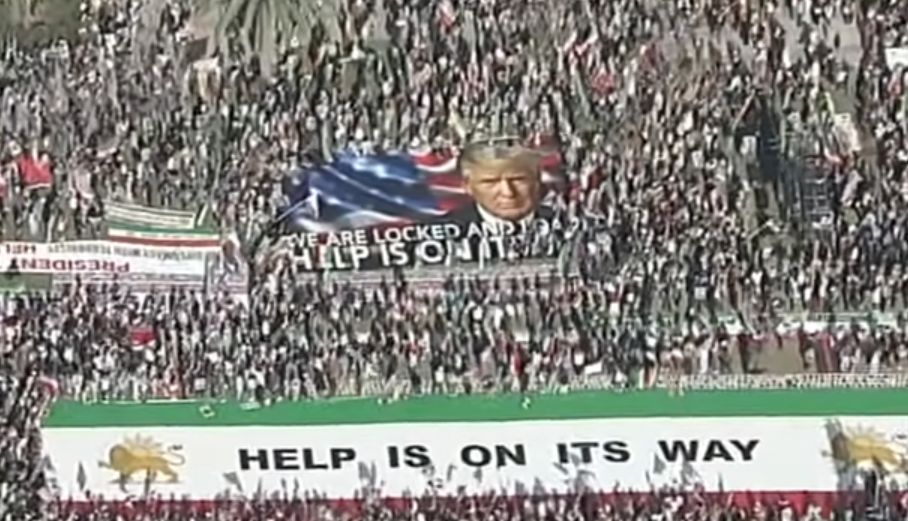
During the worldwide protests in January 2026, millions of Iranians looked to President Trump, asking for military intervention to stop the genocide and massacres carried out by the murderous Iranian regime. President Trump kept his promise to the Iranian people: “Help is on its way.” President Trump is the
One destined to fulfill the divine mission of God to end the extremist Islamic regime in Iran and liberate the oppressed Iranian people from this murderous regime.
 |
The Supporters of
Iranians rallied in Los Angeles on February 14, 2026 |
Therefore, it is God’s judgment that the extremist Islamic regime in Iran must come to an end, following its massacre of more than 35,000 unarmed protesters in January 2026. With most of the leaders responsible for this atrocity now eliminated, the remaining Iranian military personnel and security forces must immediately end all forms of repression against Iranian
people and halt any further aggressive actions toward neighboring countries. Lay down your weapons and support the establishment of a new democratic government in Iran to enable a more stable and prosperous future for the country.
God has mercy on the oppressed Iranian people who have endured prolonged hardship under this regime. The time has come to close the chapter on Iran’s Dark Age under the brutal rule of this extremist regime. This is the divine revelation of God for the future of
Iran and for the enduring peace across the Middle East.
Download
the PDF Version of this Revelation on the War in Iran