III. The Causes of Conflicts between Russia and Ukraine
Although Ukrainians and Russians share the same ancestors and a common culture spanning over a thousand years, there were some historical events that have created lasting tensions between the two nations. The most significant of these were the Soviet-Ukrainian War (1917–1921) and the Holodomor (1932–1933).
1. The Soviet-Ukrainian War
/War of Independence (1917-1921)
After the Bolshevik Revolution in 1917, Ukrainians declared autonomy as the Ukrainian People’s Republic. The Bolshevik government in Soviet Russia, led by Lenin, viewed this as a counter-revolutionary move and refused to accept Ukrainian autonomy.
In January 1918, Ukraine declared full independence. War broke out, and the Soviet Red Army, supported by local Bolshevik forces in Kyiv, eventually defeated the army of the Ukrainian People’s Republic. Ukraine was forcibly incorporated into the Soviet Union in 1922. However, Stalin remained deeply suspicious of ethnic Ukrainians’ loyalty to the Soviet regime. This distrust later contributed to the Holodomor of 1932–1933.
2. The Holodomor: The
Terror-Famine in Ukraine (1932-1933)
Between 1932 and 1933, a devastating famine swept across the Soviet Union, hitting Ukraine particularly hard. The Soviet government under Stalin seized grain from Ukrainian farms for export to fund its industrialization plans. Stalin rejected international aid, confiscated food from peasant households, and prevented Ukrainians from leaving their villages in search of food. As a result, an estimated 3 to 5 million Ukrainians starved to death.
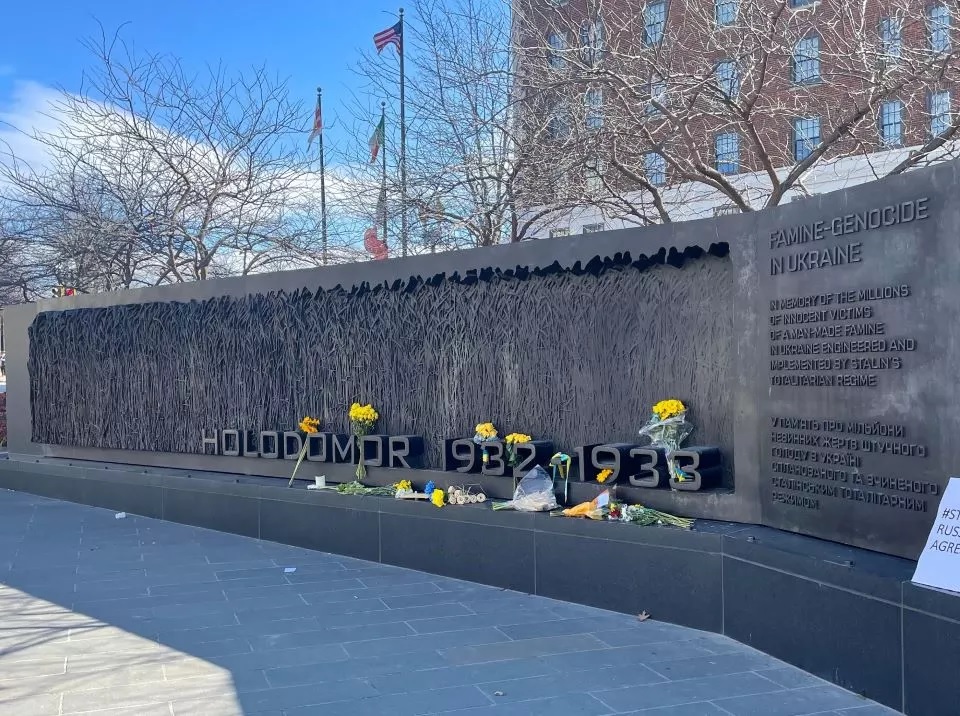
The Holodomor was a man-made terror-famine deliberately exacerbated by Stalin, who believed that ethnic Ukrainians — especially those in western Ukraine — were disloyal to his regime.
Joseph Stalin is one of the most murderous leaders in world history. During his rule, approximately 20 million people were killed or died as a result of persecution under his orders, including the 3 to 5 million Ukrainians who perished in the Holodomor.
During World War II, while the majority of Ukrainians fought alongside the Soviet Red Army against Nazi Germany, some Ukrainians joined German forces to seek revenge for Stalin’s policies. Certain Ukrainian nationalist groups, notably those led by Stepan Bandera, collaborated with Nazi Germany in hopes of gaining independence from the Soviet Union. This history remains the root of extremist Ukrainian nationalism and Neo-Nazism in Ukraine today.
The Holodomor remains a profound trauma in Ukrainian national memory, comparable to the Holocaust for the Jewish people. After Ukraine gained independence in 1991, many Ukrainians began openly commemorating the Holodomor. While most developed a stronger sense of Ukrainian national identity, a small minority turned toward extremist nationalist or Neo-Nazi ideologies.
3. The Euromaidan Revolution of Dignity in 2014
After gaining independence, many Ukrainian government officials became corrupt, much like the Russian oligarchs, and plunged the country into economic stagnation. In November 2013, Ukrainians launched the Euromaidan protests against the government after President Viktor Yanukovych abruptly backed out of an association agreement with the European Union in favor of closer ties with Russia.
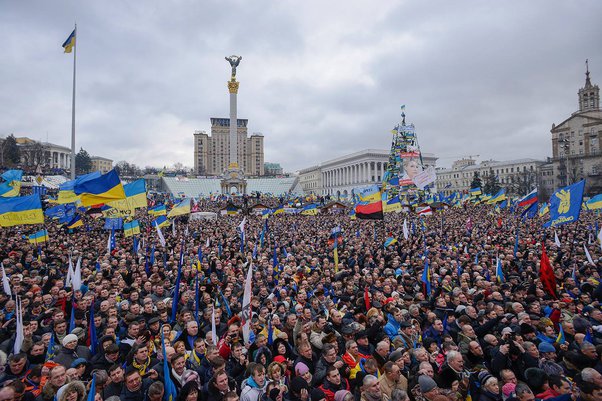
In February 2014, Ukrainians escalated the protests into the Revolution of Dignity (also known as the Maidan or Euromaidan Revolution) with the goal of ousting pro-Russian President Viktor Yanukovych. Yanukovych ordered security forces to violently suppress the demonstrations, resulting in approximately 80 deaths in February 2014. Following the bloodshed, the Ukrainian parliament turned against him and voted to remove him from office on February 22, 2014. Yanukovych subsequently fled to Russia.
4. The Annexation of Crimea
After the pro-Western Ukrainians ousted
the pro-Russian president, ethnic Russians in eastern and southern Ukraine began holding rallies against the new government in Kyiv. Amid rising anti-Russian sentiment, Russian President Putin decided to seize Crimea, where Russia’s Black Sea Fleet was stationed.
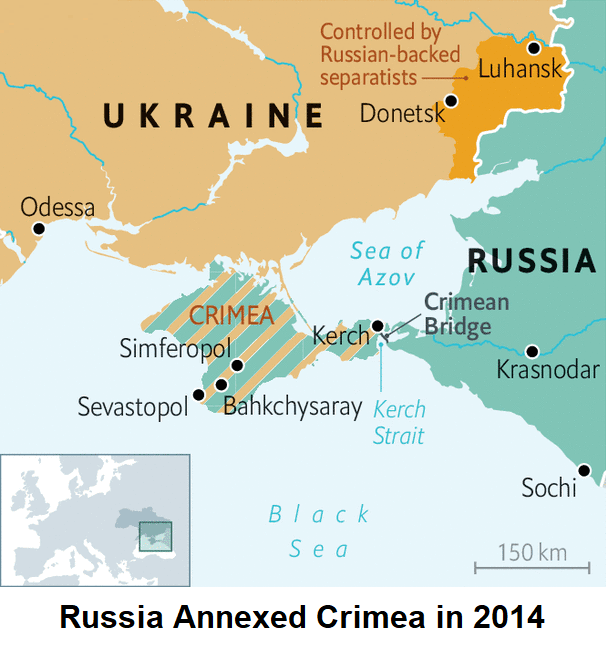
On March 1, 2014, Russian troops were deployed to Crimea and quickly took full control of the peninsula. On March 16, 2014, a controversial referendum was held in which Crimeans were asked to choose between independence from Ukraine and joining Russia. According to official results, 97% voted in favor of joining the Russian Federation, with an 83% voter turnout. On March 18, 2014, Russia formally annexed
Crimea into the Russian Federation. Ukraine and the United Nations do not recognize the referendum or the annexation as legitimate.
5. Separatism in Eastern Ukraine
Following the Revolution of Dignity in 2014, Russian-speaking residents in the Donetsk and Luhansk regions held a referendum on May 11, 2014, declaring independence from the new pro-Western Ukrainian government. Many ethnic Russians in the region expressed a desire to eventually join Russia. At the same time, pro-Ukrainian residents in other parts of Donetsk and Luhansk Oblasts held counter-referendums supporting continued membership in Ukraine, with some favoring accession to Dnipropetrovsk Oblast.
At this stage, Russian President Putin did not formally recognize the independence of Donetsk and Luhansk (unlike Crimea), hoping to maintain some influence over Ukraine. However, he provided military support, including Russian troops, to the pro-Russian separatists fighting against Ukraine’s Armed Forces.
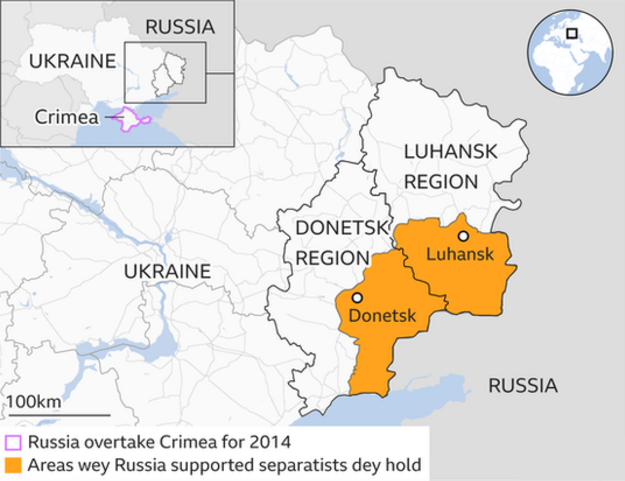
In August 2014 and February 2015, the Ukrainian government and the pro-Russian separatists signed the Minsk I and Minsk II Agreements aimed at achieving a ceasefire. However, both agreements were repeatedly violated and ultimately failed. Over the next eight years, Ukrainian troops and volunteer battalions fought Russian-backed separatists in the Donbas region. The conflict resulted in over 13,000 deaths, including 3,393 civilians — most of them ethnic Russians (according to UN reports). Had the Ukrainian government offered the separatist regions meaningful autonomy, the full-scale Russian invasion of 2022 might have been avoided.
6. Nationalism and Neo-Nazism in Ukraine
Since Russia’s annexation of Crimea and the separatist rebellion in Eastern Ukraine in 2014, Ukrainian nationalism has risen significantly among Ukrainians.
While most expressions of this nationalism reflected legitimate patriotism, a fringe element turned toward extremist groups and Neo-Nazi ideology.
According to reports from Amnesty International, Human Rights Watch, and the Office of the United Nations High Commissioner for Human Rights
(OHCHR), some of these neo-Nazi extremists carried out brutal torture and killings of ethnic Russian civilians in Eastern Ukraine during the conflict with separatists.
These atrocities inflamed anti-Ukrainian sentiment and fueled calls for retaliation
inside Russia. This became one of the pretexts Putin used to justify the “denazification” of Ukraine in his “Special Military Operation.”
7. The New Language Law
In 2019, Ukraine enacted a new language law that requires government officials, print media, schools, and service sectors to use the Ukrainian language and imposes restrictions on the use of Russian in public spheres. The law also imposes fines on businesses for non-compliance in customer service.
The law caused deep resentment among the large Russian-speaking population in eastern and southern Ukraine (estimated at around 40% of the country’s total population at the time).
Russia strongly condemned the law in both the United Nations General Assembly and the Security Council. It became another
grievance contributing to Putin’s decision to invade Ukraine in 2022.
8. Ukraine’s Desire to Join NATO
After losing Crimea and facing years of conflict with Russian-backed separatists, Ukraine’s government placed NATO membership at the top of its national security agenda. Russia, however, viewed NATO expansion to its immediate border as an existential threat. Moscow feared that a NATO-aligned Ukraine could eventually serve as a platform to retake Crimea by force. Ukraine’s stated goal of eventual membership of NATO became one of the central triggers for Russia’s full-scale invasion in February 2022.
9. Putin’s Ambition for a New Russian Empire
Another main cause of this war in Ukraine is Putin’s personal ambition
of restoring Russia as a great empire, echoing the eras of Peter the Great (reigned from 1682 to 1725) and Catherine the Great (reigned from 1762 to
1796). However, times have changed. This is the time for the New Millennium of Peace and Wisdom, not the
time for military invasion or dominance over other countries.
Putin’s ambitious but outdated dream of a new Russian Empire has turned into a nightmare for Russia. It is time for Mr. Putin to recognize reality and find the courage to end this war. Otherwise, he will be remembered in Russian history as the leader who destroyed Russia’s economy and isolated the country from the world — unlike Peter the Great, who embraced the West to modernize Russia.
10. Bad Karma for Both Nations
The roots of this tragedy run deeper than the events of 2022. Before Russia invaded Ukraine in February 2022, there was some bad karma for both nations that eventually led to this catastrophic disaster.
Since gaining independence in 1991, Ukraine — like many other former communist countries in Eastern Europe — struggled with economic hardship caused by the transition period and widespread government corruption. Many Ukrainians were frustrated with pro-Russian government and sought closer ties with the European Union, which led to the Orange Revolution in 2004 and the Euromaidan Revolution in 2014.
On one hand, Russia supported pro-Russian governments that suppressed democratic protests with excessive force and even poisoned opposition leader Viktor Yushchenko in 2004. This was bad karma for Russia,
which turned more Ukrainians away from Russia and toward Europe. Yushchenko was eventually elected president.
On the other hand, after the Euromaidan Revolution in 2014, many pro-Russian residents in the Donbas region sought independence from Ukraine or integration with Russia. Ukraine’s military response, while understandable from a sovereignty standpoint, involved documented cases of excessive force and civilian casualties. Over the eight years of Donbas conflict (2014–2022), more than three thousand ethnic Russian civilians died, with some extreme nationalist militias committing documented atrocities of torture and killings of pro-Russian civilians, including women and children. These actions caused bad karma for Ukraine, which led to the Russian invasion in February 2022.
When one nation commits crimes against civilians of another — especially women and children — it generates bad karma for its own nation, which will cause misfortune and disasters upon itself. This is the Principle of Karma for All
Nations — the "iron scepter that rules all nations" prophesied in
the Book of Revelation (12:5 & 19:15).
Since Russia’s invasion in February 2022, Russian forces have caused over ten thousand civilian deaths through indiscriminate bombing and shelling. These actions have generated bad karma for Russia as well, potentially bringing further misfortune and disasters upon the country.
The only way forward is for both nations to acknowledge their share of responsibility, abandon maximalist goals, and negotiate a sustainable peace. By continuing this conflict, both sides will only accumulate more bad karma, risking far greater catastrophe — for Ukraine, for Russia, and potentially for the entire world.
IV. The Peaceful
Solution to End the War in Ukraine
I | II
| III | IV
The Divine Revelation on the Peaceful Solution to End the War in the Middle East
God Bless!